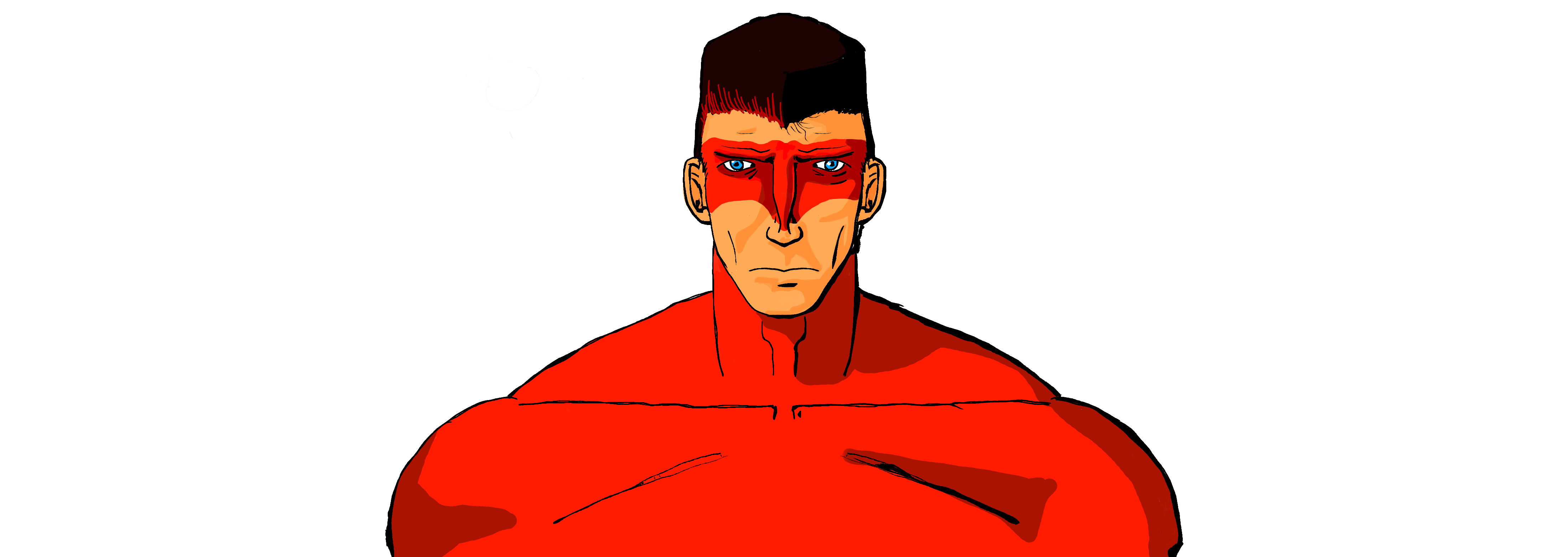
 What do Daniel (yes, the one in the Bible), King David, Sam Gamgee, and Superman all have in common? They are all considered “heroes,” whether historical or imaginary, that embody certain traits that people value. However, do fictional heroes, superheroes or otherwise, have enough depth to be proper role models? A common complaint against modern superheroes is that they are too perfect–they don’t resemble real people. Real people have flaws, they make mistakes, they make unwise decisions. And so it is only natural that we want to hear stories about people like us–not perfect folks but people with vices. So here’s a question:
Do superheroes (or even “regular” old heroes) have a place in fictional literature? Feel free to discuss!
-Joseph (and Jack)-
“Real people have flaws, they make mistakes, they make unwise decisions.” True, but that still doesn’t keep real people from acting like heroes. I say that if heroes exist in real life, they have a place in fiction.
Thanks for chiming in!
“I say that if heroes exist in real life, they have a place in fiction.”
Now that got me thinking! I’m not sure this is where Joseph wants to go with this discussion, but here goes anyway:
I definitely agree that “heroes” exist in real life, but they aren’t perfect heroes. They’re 3 dimensional and usually change over the course of a story. Those are the kinds of heroes we typically encounter in stories in this day and age. But what about one-dimensional heroes? Maybe Beowulf or (arguably) Sir Gawain or Aslan? Or Superman, I suppose (to keep this discussion focused, tho I’ve always thought the original Superman was a mite boring)? Characters who are one-dimensional in the sense that they never seem to change because they are too busy doing the right thing. Characters who don’t even seem to have consciences–they just do the right thing instinctively, as if it’s in their nature. On the one hand, they could be considered boring or unrealistic as characters, but perhaps they serve a purpose in literature beyond that of simply being an interesting character…
So now what I’m wondering: do one-dimensional heroes such as Superman, Aslan, or (maybe) Sir Gawain have a place in fiction, despite the fact that they don’t exist in real life?
Just musings, preciate the input, hope Joseph doesn’t chew me out ;-),
Jack
-Ahem- I guess I should have left Aslan out since he allegorically represents Jesus…overtly, unlike the other people I listed. I wonder how Christological heroes like Aslan fit into the literary scheme of things… -Jack
At least in the case of Aslan, a more one dimensional hero works because the author devotes much more time to characters who do have flaws. Another hero that springs to mind is Hector. Since he was not really the main focus of the story, his lack of flaws does not irritate.
As to the original list, David and Sam had some fairly significant flaws. Daniel didn’t (that we know about), but I think his complete dependence on God keeps him from being boring. He knew that he wasn’t perfect – thus all the praying!
And Superman is really, really dull. Even Batman bored me fairly quickly because of the ridiculous “no villains were harmed in the making of this story” aspect. Maybe I just haven’t found the right super hero yet?
Christological heroes usually show up in preachy, obnoxious, sentimental books. Unless the author is really, REALLY good, leave Him alone. He doesn’t need the bad publicity. 😉
Miller’s Singer Trilogy does a good job with it though.
Have to look that one up and see if I can get it from the library!
Agreed about the Superman business generally. DC began the superhero trend I think, but it was Marvel that really began the “humanizing” process to make the heroes less dull–take Peter Parker for instance; I don’t find him all that one-dimensional, maybe because he had so many tough decisions to make. Unlike Superman, his powers didn’t make him too distant or perfect–he never seemed like a “god.” He’s sort of like Cary Grant in Arsenic and Old Lace–so in over his head (gotta save NY, keep that date with MJ, and pay the rent on the apartment) that the audience doesn’t mind that he doesn’t experience much character growth. Not perhaps an apt comparison, but…
Maybe one-dimensional heroes can work as main characters as long as they suffer a lot? 🙂
Of course, all my views on Spiderman may change with the forthcoming reboot. Spidey’s rep seems to be getting tarnished with all the commercialization.
Hmm…I guess I should have prefaced that last reply by asking whether or not you find Spiderman boring like Superman and Batman? I personally think he’s a lot more interesting than Superman (and possibly Batman), but that’s subject to debate I suppose. Maybe it’s just the situations Spidey finds himself in tend to be more interesting than those of Superman and so I convince myself that Parker must also be a more interesting character…I dunno.
Since your post was pretty long, I’ll be somewhat freer with my thoughts. 🙂
I must confess I have very little exposure to Superman (just the first film with Christopher Reeves–and that was pretty cheesy) or any other comics, so I can’t really comment on him. However, both Beowulf and Sir Gawain (at least in the original poems) are from “worlds” where nobody has much character in my opinion, therefore I don’t really find them annoying. Interestingly, I’ve noticed that whenever I read re-tellings (“novelizations”) of Sir Gawain, they’re always ready to give him plenty of flaws (such as in The Once and Future King).
However, I think, as long as they’re not “stretched too thin,” I think “one-dimensinoals” can serve a purpose. After all, people need someone to look up to, someone who always makes the right decisions, so that we can follow their example. Obviously Jesus is the perfect example, but I don’t think it hurts to have occasional mortal heroes.
I’ll try to be verbose once more so as to let you be freer with your thoughts ;-).
I think I see what you mean about 1D heroes being all right as long as they’re not stretched too thin. It’s funny, I can’t think of a really recent story with a 1D hero. Nowadays, 3d is all the rage! I guess the level of one-dimensional-ness also depends on what the author chooses to dwell on. No doubt the author of Sir Gawain or Beowulf could have chosen to dwell on negative aspects of their characters (Maybe Gawain had a gluttonous desire for chocolate?!), but instead the authors chose to focus on the positive–the inspiring aspects of their characters…I can’t remember where I was going with this…
Anyway, a tangential question then could be: do readers learn/benefit more from watching a person do the right thing or from watching a person learn to do the right thing? In the first case, we are talking about the one-dimensional picture-perfect hero of yore, and in the second case we are talking about the “flawed but sympathetic protagonist” who changes into a less flawed person by the end of the story (unless it’s a tragedy, in which everything goes to pot).
Superman is the ubermensch. He’s always boring. He only has one flaw. The ubermensch is incredibly selfish viewing himself as indestructible. That is why Batman is the greatest superhero – he has no super powers except his will. Characters who do solely the right thing(or what the author believes is the right thing) are called paragons. Characters may be role models in one respect but not in others. Howard Roark in The Fountainhead is an example of a paragon on one end of a spectrum. All other characters in The Fountainhead are measured in relation to him and his nemesis Ellsworth Toohey. Howard Roark has some admirable qualities though he also possesses (from a Christian perspective) some unadvisable qualities. Howard Roark was conceived of as a paragon to show forth the author’s idea of the perfect man. His purpose was conceived of as a perfect role model. He isn’t. Is there value in assessing character traits by personifying them and placing them in a spectrum with other personified character traits? Will the viewing of these personified character traits aid in the cultivating of these traits?
There is a difference between an excellent role model and a realistic role model, though the two are not mutually exclusive. When you say “deep character” are you thinking of both virtues and flaws coexisting and/or conflicting in the same non-paragon character? Because, that’s Jack Bauer right there. He does what he perceives is his duty even if it costs him his family, friends, life, and everything else. Jack is not a paragon – so much so that he is a type IV anti hero. Jack Bauer functions as a realistic man dealing with impossible options no one wants to deal with. Jack Bauer functions as a realistic picture of realistically and morally ambiguous situations. He’s not perfect. Is there value in ruminating on the importance of making hard decisions and their consequences in the person and actions of an antihero?
It would seem that sinless heroes who go through no inward or outward disgruntling trials may be less than sympathizable. Sam has relatively few inward trials but instead deals with others who face trials. Sam is at first only a subordinate following the one who carries the ring, then is more directly placed to deal with those affected by the evil of the ring, eventually taking the ring to destroy it himself. Sam’s personality remains mostly static. The question is not whether Sam is boring, but whether Frodo is boring. Frodo does the right thing 99% of the time and experiences personality changes, but does that make him an interesting character? Does that make him a proper character? Does Sam project moral qualities that reflect the image of God? Does thinking of Sam as an example help Christians to live a moral life? Does thinking of Sam help non-Christians live a moral life? Does thinking of Frodo as an example of the consequences of sin help Christians to see the heinousness of sin?
I seem to remember Aslan being a faulty allegorical representation of Jesus. Something about ransom theory….. Besides, if I remember correctly Aslan was described as “wild” and given to mood swings. Correct me if I’m wrong.
When was Spider-Man not commercialized? He was created as a comic book to be sold to teenagers. What is uncommercial about that? Spider-Man has been commercialized for 50 years.
These questions are rhetorical – do not feel obligated to answer them
Sorry it took me a while to reply. I agree Spiderman’s more interesting than the other two. I’m starting to think it’s the whole “must reset the plot so we can continue the series” attitude of most comic heroes that makes me less interested. Parker IS much more relatable – and likeable, for that matter – but he faces the same problems over…and over…and OVER. So it’s not his fault I get bored with him…it’s his creators’. 😉
Yes–definitely creators’ problem. Some writers take good ideas and run them into the ground because they can get more money that way…or so it seems to me.
Thanks for discussing! This discussion has been fun for me at least, and it’s helped me think things through more than I am normally apt to do.
Most of your rhetorical questions go over my head, but I will try to give you my thoughts about Aslan as an allegory of Jesus.
Yes, I think that the way in which Aslan had to “ransom” Edmund from the White Witch did not seem to be a very good allegory of Jesus’ sacrifice. Jesus was not “ransoming” sinners from Satan (a.k.a. the White Witch) when he died on the cross. He was dying to pay for what our sins deserved. We were dead in sin, not prisoners of Satan (a.k.a. the White Witch). I hope that this makes sense.
Now, about your other comment on Aslan. I do not think that he was prone to “mood swings,” although Mr. Beaver did say about Aslan in The Lion, the Witch, and the Wardrobe “He’s wild, you know. Not like a tame lion.” I am almost clueless as to what C. S. Lewis meant this “wildness” of Aslan’s to be an allegory of, or if he even meant it to be an allegory of something.
Aslan may have had other faults as an allegory of Jesus, but I cannot recall any specific ones right now.
This won’t really answer any of your questions, but I thought I’d put up some of my own thoughts. Personally, Sam was always one of my favorite characters. I liked that he didn’t change, he was completely reliable and could always be counted upon to do the honest and right thing. I guess Sam’s consistency, even if unrealistic, made me prefer him to Frodo, or really any of the other characters. However, I’m a slave to routine and predictability so that may explain why I like Sam so much.
That being said, I think that a more static character, like Sam, might be harder to sympathize with and relate too (like you mention). However, at the same time, I think that a consistently “good” character who endures outside struggles and does not compromise his beliefs can still have an interesting a positive role in a story. I can generally sympathize with a character that seeks to do good, and yet is constantly confronted with evil. Also, I think that the example of Sam’s (or insert your own character) behavior that is never compromised based on his situation can be a positive model for readers to emulate. After all, we as Christians should never compromise our behavior or speech based upon where we are or who we are with.
Batman also has ridiculous monetary and technological resources that allowed him to exert his wishes. Will is nice, but it’s hard to stock that bat-belt and bat-helicopter without $$$. The true American hero: with enough cash and obsession, anything is possible.
One question: Without a ‘hero’ do you even have a story?
In my opinion, no.
I’m not a comic-book person, so I don’t know about this 1D stuff you are talking about. Actually, to be more precise, I have never thought of characters who don’t show much change as one-dementional. I certainly wouldn’t say Sam Gamgee was 1D! (I love Sam 🙂 ) If all characters were 1D it would be boring…but some characters need to be–they are a grounding, of a sort–like Sam; one can always count on Sam to be steady and reliable. (For me, to be compared to Sam is a high complement.)
About Aslan–the ‘wild’ bit and mood swings–I think that the point is Aslan is beyond human (or talking animal) comprehension. Like we cannot really, truely know much about God, neither can Aslan’s folk fully understand him (and may even misinterpret his actions).
Racheal, have you ever read Wuthering Heights? There’s a story without a hero or anyone to cheer. Each character is so unpalatable I eventually decided they all deserved the misery they inflicted on each other and returned the book.
Did anyone say Sam was 1D? I love him because he’s so faithful and focused, but he also had his own issues if I recall (it’s been a while since I read the book, so I’m open to correction). He’s an eavesdropper, isn’t much of a looker, and doesn’t always come across as the most brilliant mind in the Shire. If Sam were a steadfast, focused, hot genius who never did something he shouldn’t, then he’d be boring.
+1 on your Aslan observation.
I haven’t really read Wuthering Heights. I read a very condensed version with lots of pictures and thought it rather depressing. I guess you are right, that story doesn’t really have a hero.
I have read Wuthering Heights twice, and agree with Mere’s assessment: there is not a single hero or character you can root for in the entire book.
As for Sam, I am in the midst of re-reading The Fellowship of the Ring, and Sam is definitely not one-dimensional. Tolkien makes all of his characters very real by giving them all distinct personalities, and Sam is no exception. You could say he is like most other hobbits: contented with the comfortable life of the Shire. But Sam is also different from other hobbits, because he is eager to learn anything Bilbo Baggins has to tell him about the old days, and he is also willing to leave the Shire if he must. I don’t think Sam is very brave at the beginning of the story, but because of his faithfulness to “Mr. Frodo,” he is willing to go through many dangers and trials, and as a result he grows in bravery. He is a very consistent character throughout the books, but he does have a bit of character development, and his different quirks make him extremely interesting and fun to read about.
Regarding the virtues of what Jehovah has added
Are you a slave of routine, or is routine your servant that working for you, helping you to accomplish work? A stable routine is a stabilizing process that regularly produces fairly consistent situations that in turn open up contemplation of anomalies that produce scientific analyses and breakthroughs; a steadily disordered series of events is generally not conducive to progress in any worthwhile endeavor, but rather a gateway to steady decline. Indeed ,the safest road to hell is the gradual one – the gentle slope, soft underfoot, without sudden turnings, without milestones, without signposts…
Regarding the differences of abilities, education, and might of Sam and Frodo
I have heard it said that Sam was less tempted by evil because he was more simple than Frodo. Sam who knew no elvish was less intellectual than Frodo who knew some elvish. Sam did more manual labor than Frodo. Sam was less acquainted with the evil of the ring than Frodo was. Which brings up the question: what did Frodo do for a job? How did Frodo pay for stuff? Bilbo’s chest of silver coins? I guess the etymology of his last name didn’t include the meaning “money bag pants” for nothing. In all obviousness and truthfulness, Sam is an exemplary role mode to be perpetually imitated in all times and all places for all eternity. Of course [movie adaptation] Sam has a take on this issue:
“It’s like in the great stories, Mr. Frodo. The ones that really mattered. Full of darkness and danger, they were. And sometimes you didn’t want to know the end. Because how could the end be happy? How could the world go back to the way it was when so much bad had happened? But in the end, it’s only a passing thing, this shadow. Even darkness must pass. A new day will come. And when the sun shines it will shine out the clearer. Those were the stories that stayed with you. That meant something, even if you were too small to understand why. But I think, Mr. Frodo, I do understand. I know now. Folk in those stories had lots of chances of turning back, only they didn’t. They kept going. Because they were holding on to something.
(Frodo)What are we holding onto Sam?(Sam) That there’s some good in this world and its worth fighting for. ”
Regarding the exaltation of those above the level of mere Batmen
You appear to be referring to Adam west, or an Adam West-like Batman. When Batman was Adam west, he possessed ludicrous amounts of monetary and technological resources allowing him to fulfill his wishes. The Adam West batman employed expensive gadgets to solve all of his problems. This is undisputed. However, I am speaking of Christopher Nolan's portrayal of Bruce Wayne. The Bruce Wayne who became batman without the use of his money. Denied his revenge for the brutal murder of his parents, Bruce Wayne became a criminal who eventually learned martial arts in Asia after wandering through several continents for seven years. Almost becoming the leader of the destroyers of decadent civilizations throughout history, Bruce realizes the difference between revenge and justice. Because Batman got all of his gear from failed department of defense contracts, that means that you paid for his stuff.
Regarding problematic soteriological anelagories
If Aslan was wild, I assume this implies he did not and will not subordinate his will to The Father as Jesus did and does. But where are the other members of the trinity to be found? It just seems a little odd that the allegorical expression of the second person of the trinity should make no references to The Father. Aslan appears to refer to himself and the witch as being subordinate to deeper magic. Should we assume that Deeper magic is an allegorical symbol for The Father? Otherwise the allegorical Jesus is all there by his lonesome. Glory is given to not The Father, to The Son, but not to The Holy Ghost. Unless you want to argue that Father Christmas represents The Father. My Bible says that magic is of the devil – and some people think Father Christmas's cousin Sanity Clause is the devil. This wardrobe of thought stops in the land in which the allegorical Jesus (Aslan) calls on magic from the allegorical devil (deep magic) to keep the allegorical devil ( the witch) from the allegorical elect (Edmund). It seems to me that if Aslan were calling on the authority of magic from the devil(deep magic) he would be working for the devil. Of course we must remember that C.S. Lewis had a mystical tinge to his theology. Does this excuse his errors? Are these real errors? If they are errors, do they effect the moral of the story? Are they insignificant? Were the stone tables meant to be representative of the stone tablets of the moral law? Because that would make even less sense. Correct me if I have erred in the mis-application of logic, reasoning, theology, grammar, spelling, common sense, and/or ignorance or forgetfulness of the source material.
Regarding the proper translation of Green knighthood
Which translation of sir Gawain the green knight is best? Do they all tell basically the same story?
Regarding the value placed on characters regardless of context
I have heard it said that Wuthering heights was written as a deconstruction of the idea that all women desire to be governed by wicked men. If this is true, and it did it achieve her purpose, does that mean the result of the simple characters when placed in order show forth the book's value? Does a book, Regardless of purpose, necessarily increased or decreased in value proportionately with the depth of its characters? Is a naturalistic book that features excrutiatingly comprehensive detail about its characters shrouded in a pessimistic and destructive worldview be raised to a higher standard than a book of allegory with more simple characters and a biblical worldview? Is the opposite the case? William Faulkner said in his Nobel prize speech that "writing today has forgotten the problems of the human heart in conflict with itself which alone can make good writing because only that is worth writing about, worth the agony and the sweat. " Perhaps the question is whether the depth of protagonists and/or other characters in connection to its ability to deal with the conflicts of the heart. Is character created by dealing with conflicts of the heart? Are both depth of character and inward trials dichotomized to mutually exclude each other by means of a black or white fallacy? Does depth of character always accompany, or merely tend to accompany inward trials? For example, is Mr. Stand fast a one dimensional character? If so, does his one dimensionality or partaking of the story effect the audience's ability to sympathize with him? Because of his infirmities, is Pilgrim/Christian more sympathizable than Mr. Stand fast? Is the existence of sin within a character and his struggling therewith a prerequisite for that character to develop depth? If struggles against sin and its effects create depth, how can God who is sinless also have depth? Is it that God's to resurrecting of those dead in sin is more glorious than their static goodness? Is the best of all worlds a glorious struggle with sin in conflict with the indwelling of the Holy Spirit (or at least its Imation) a foundation for good literature? Even Jesus had to bear suffering and struggle for a lifetime. Does Aslan do this? If the more sinful a person is the more glorious his sanctification and the more difficult the task the more glorious the completion, it would it not necessarily follow that the more trials a protagonist faces and the more exposed to temptation the more glorious, noble, and victorious the character? The more difficult the task the more glorious the completion. We behold Kenny's foot as more glorious because we know that it has been in a reconstruction device for the past two months. To read a 1000 page novel is more glorious an achievement to read than to read a Dr. Seuss book because of the perseverance required to reach the goal. Rarely does anyone praise couch potatoes. Why? They do rarely do anything praiseworthy. But the question remains: if a one dimensional characters are less praiseworthy and less sympathizable do they lose their purpose in the story if they are the hero, or do they merely become less palpable? Are they not properly been touched with our infirmities? Consider the mentally insane. They neither sow nor reap, yet The Lord feeds them. Of how much more worth are heroes than psychopaths? By the way, all of the American presidents were in some form or other insane. The lower the trough, the higher the peak.
What is character growth? Do quirks amount to it? If character is a transcript of the choices you make , then does a character doing more actions deepen his character?
Disclaimer: Most of these questions are rhetorical – do not feel obligated to answer them.
What about real heroes? Although there may not be anything wrong with superfluous “heroes” (such as Superman, Batman (I have only seen one episode of Batman from a TV series done in the 60’s, and I found it extremely cheesy, and I really disliked how the sidekick used profane expressions every other sentence) etc.) I personally prefer real or real-like heroes.
I am quite fond of Sam Gamgee, and always enjoyed the Narnia series (I haven’t read it in ages) though I never tried as I recall to pick out the allegory, I just enjoyed the story! Maybe that says I have a shallow mind, but nevertheless, I haven’t gotten to the point of what I wanted to say yet.
People (just regular ‘ol people), are different. Different people have different personalities. Some folks are steadier and more “level headed” then others, while some might have a tendency to act before they think. Some may spend a very long time thinking about something before they act upon it, while others may be capable of making quick, but well thought out responses to circumstances. So just as there is variety in people, should there not logically be variety in literary heroes?
For example (as unsuited as it may be), I have started more than once to read the Elsie Dinsmore series. Now of course while she is not really held up as being a “hero”, she obviously is the heroine, the main character of the story. I could never get past Elsie’s un-realness. I am sure that there really are some people out there who are that kind of perfect, but it always struck me as unrealistic, at least in application as a “role model” for myself. Of course she wasn’t really perfect, but she was as close to perfection as one can get I think.
It has been a couple of years since then, but at the time I wished for a “role model” who was a little more real, whose struggles were a little more common, and whose lessons learned a little more generally applicable.
Someday though I think I will read the Elsie Dinsmore series…maybe, but I have lots of other things to read first 🙂
For the most part my heroes don’t come out of books or movies, they are real people (that is not to say that I have a problem with heroes who exist on the silver screen or between the covers of a book, not at all). My heroes are men (and women) who were/are strong in the faith, and who had/have all the graciousness and pluck that flows from that. George Washington, Robert E. Lee, Stonewall Jackson, and Helen Ellis, just to name a very few….
So yes, I do think that heroes have a place in fictional literature. If they have various types of characters, and if some of them have more character growth throughout a story than others, maybe this is just art imitating life. But when you try to make a role model out of a superhero, then life begins to imitate art…and that could lead to big problems. All that is not to say that one cannot learn proper moral standards or good character traits from a superhero, but he will always in the end turn out being shallow, and unreachable, because he is “super”, out of the reach of practical everyday life.
So that is my ramble on the subject (though I think it may consist more of a ramble on a rabbit trail then in the main vein…)